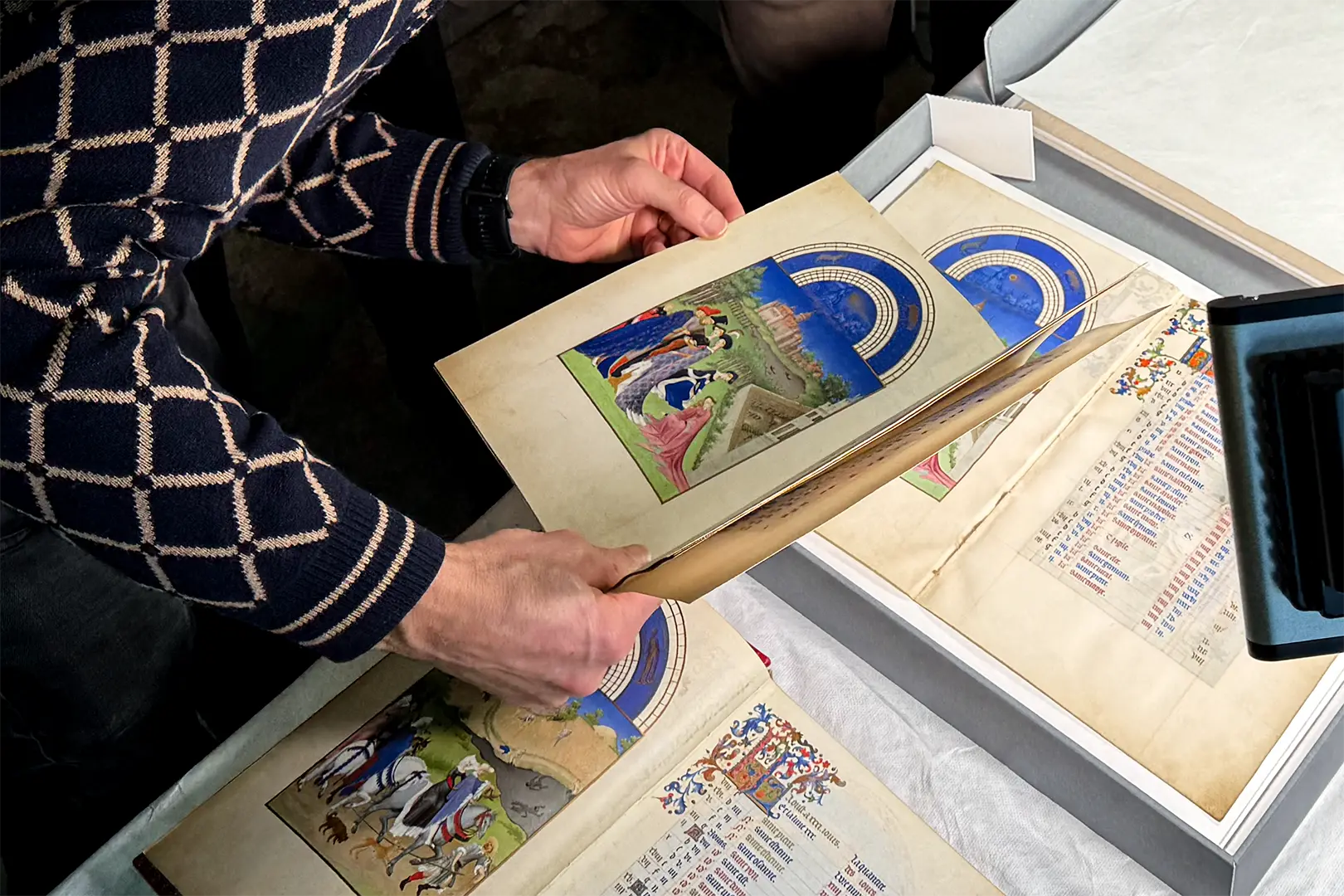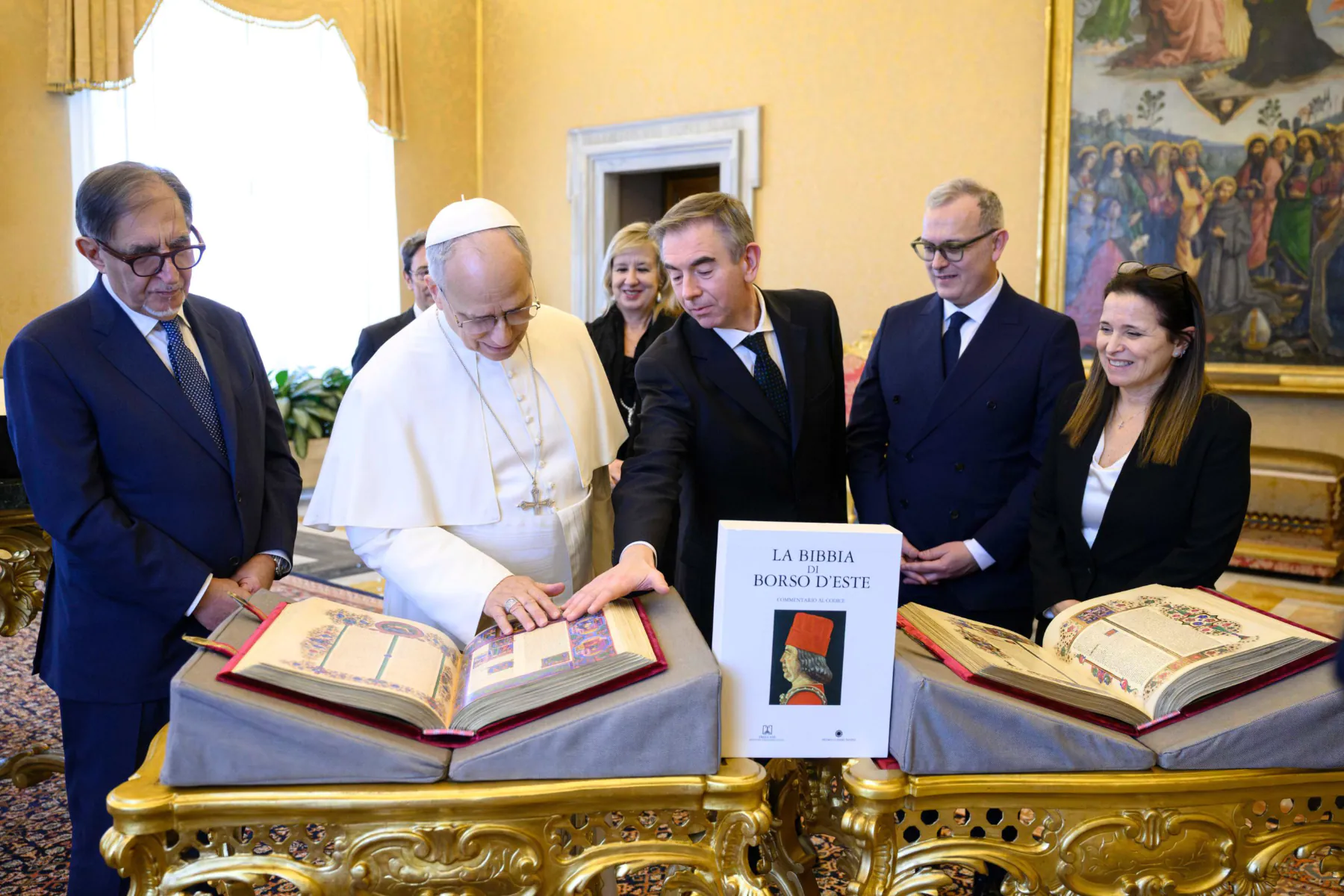
As part of the initiatives linked to the Jubilee, Luca and Lucia Panini, co-founders of Panini Cultura Group, donated to Pope Leo XIV the facsimile of the Borso d’Este Bible, produced by Franco Cosimo Panini Editore.
The presentation took place during a private audience and coincided with the official presentation to the Pontiff of the original manuscript, held at the conclusion of the exhibition dedicated to the Borso d’Este Bible at the Italian Senate. After Paul II, Pius IX, and John Paul II, Leo XIV is the fourth Pope to have personally examined the codex – and the first to receive it in the Vatican after more than five centuries.
During the meeting, the original manuscript was directly compared with the facsimile produced by Franco Cosimo Panini. This exceptional opportunity allowed for close observation of the extraordinary fidelity achieved in reproducing the colors and gold of the illuminations, as well as the paper’s texture and every material detail of this Renaissance masterpiece.
The facsimile presented to the Holy Father occupies a central place in the Panini family’s publishing history. It was the first major facsimile project undertaken by Franco Cosimo Panini following his experience in collectible stickers and marked the beginning of a new entrepreneurial and cultural direction. With the Borso d’Este Bible, Panini recognized the need for a radical shift in the reproduction of illuminated manuscripts, which at the time relied on techniques unable to convey the material and chromatic complexity of the originals.
The completion of this ambitious project required six years of work: the same length of time taken by the fifteenth-century illuminators to complete the manuscript itself. Conceived as both a technical and methodological challenge, the project established new standards of accuracy and rigor and played a key role in the emergence of a specialized field dedicated to high-end facsimile publishing.
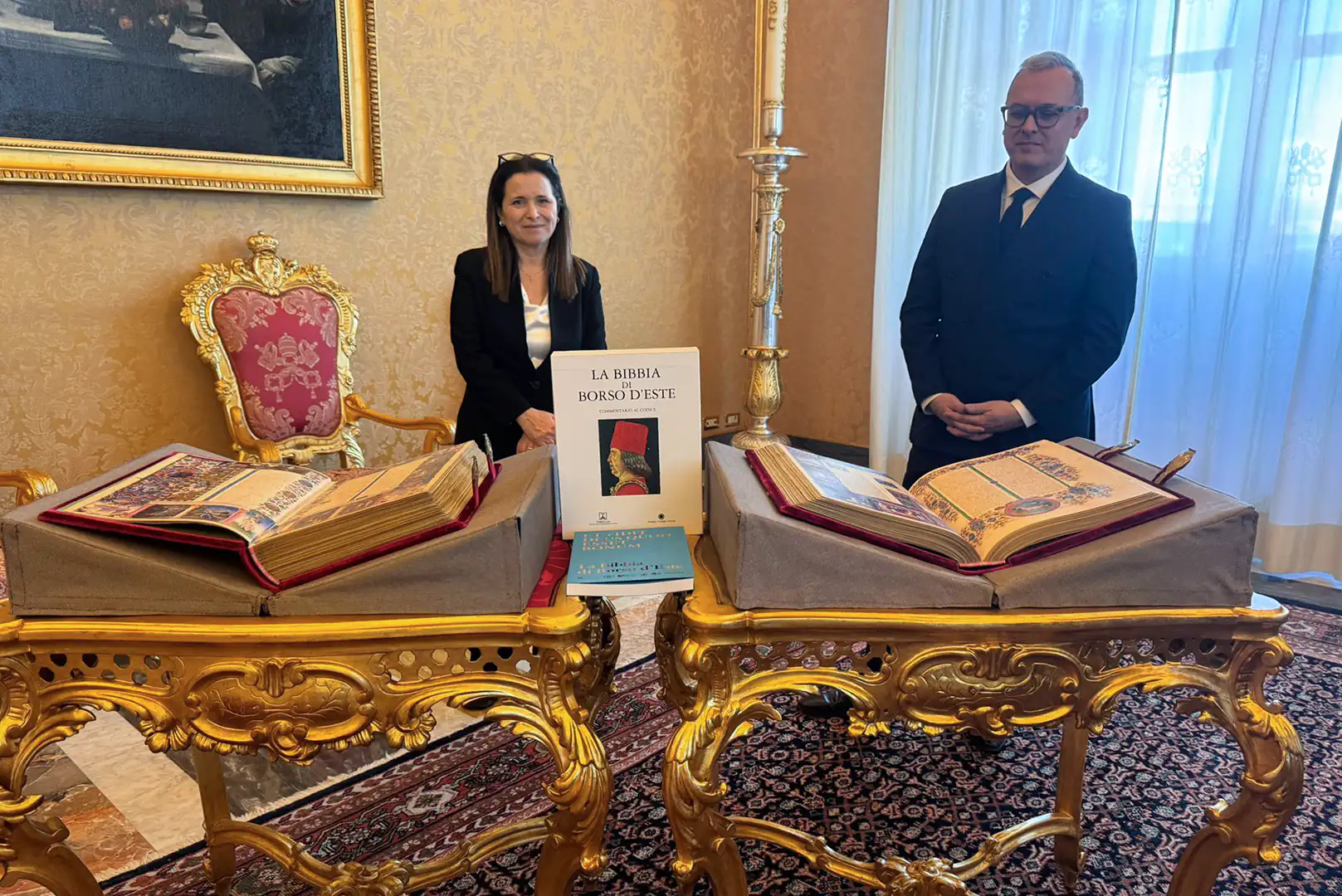
More than thirty years later, and after nearly thirty facsimile editions, the Borso d’Este Bible remains one of the most complex works ever undertaken, as well as a foundational project that continues to influence contemporary practices in the study and reproduction of book heritage.
Today, that pioneering experience continues to evolve thanks to technological innovation developed by companies within the Panini Cultura network. The expertise acquired in facsimile reproduction now works alongside advanced gigapixel and 3D acquisition tools, enabling increasingly precise projects for the reproduction and enhancement of illuminated manuscripts.
The donation of the facsimile to the Holy Father therefore represents a moment of continuity between past and present – between editorial craftsmanship and technological innovation – reaffirming the value of reproduction as a means of preserving and transmitting cultural heritage.
The visit and presentation were organized at the initiative of the President of the Italian Senate, Ignazio La Russa, together with Senate Secretary General Federico Toniato and Alessandra Necci, Director of the Gallerie Estensi, marking the conclusion of the exhibition hosted at the Senate.